
Hook Opening
Every kilogram of water launched to low Earth orbit costs tens of thousands of US dollars. For long-duration crewed space missions, resupplying unlimited fresh water from Earth is economically unfeasible—making closed-loop wastewater recycling the backbone of sustainable human spaceflight.
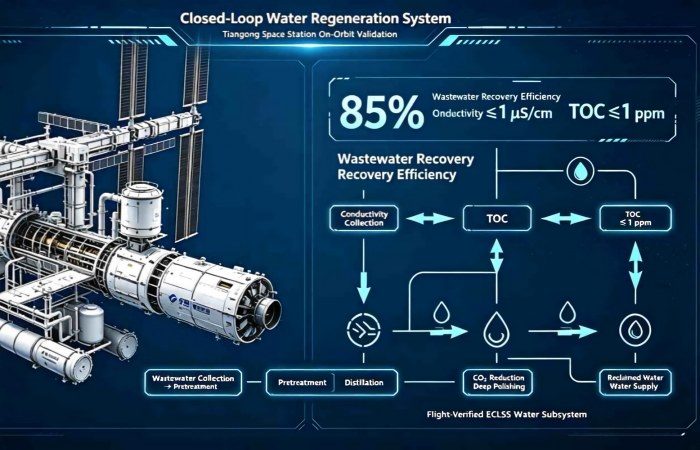
While NASA and ESA have advanced water recovery systems on the ISS, China’s Tiangong Space Station has delivered independent, fully verified regenerative water treatment technology with a verified 85% total wastewater recycling rate after years of on-orbit crewed testing. A newly published research paper reveals the station’s integrated ECLSS water subsystem architecture, on-orbit water quality benchmark data, and key differences between ground test wastewater models and actual in-space wastewater composition. This article breaks down the system design, performance metrics, and industry implications for lunar habitats, deep-space missions and terrestrial closed-loop water treatment.
1. Core Pain Point: Water Scarcity for Permanent Orbital Habitats
Long-term crew residence in space creates diverse wastewater streams: urine, cabin condensation water, and reductive water generated from CO₂-H₂ catalytic reactions. Without high-efficiency recycling, frequent cargo rocket launches are mandatory to deliver potable water, electrolysis feedwater for oxygen production, and platform process water.
Traditional open-loop water systems cannot support multi-year continuous crew operations. Closed-loop Environmental Control and Life Support Systems (ECLSS) solve this bottleneck by converting all in-station waste fluid into pure reusable water, cutting reliance on Earth resupply.
2. Integrated Water Regeneration Subsystem Architecture of Tiangong
China’s space station water recycling framework combines three interdependent subsystems to close the water cycle fully:
- Urine Treatment Subsystem Urine undergoes chemical preprocessing before vacuum distillation to produce purified urine distillate, eliminating organic and inorganic waste from human metabolic fluid.
- CO₂ Reduction Subsystem Sabatier-style catalytic reduction of cabin carbon dioxide and onboard hydrogen generates reductive water, capturing water vapor from atmospheric waste CO₂.
- Central Water Treatment Subsystem Urine distillate, CO₂ reductive water, and cabin condensation water converge here for multi-stage deep purification, yielding ultra-pure regenerated water for all onboard demands.
All three streams feed into one unified polishing unit to standardize water quality before distribution across the station.
3. In-Orbit Wastewater Characteristics: Ground vs. On-Orbit Discrepancies
Researchers conducted comprehensive lab analysis on wastewater and regenerated water samples returned from multiple crewed missions, with two critical findings:
- Pre-treated urine, distillate, reductive water and condensate all fall within the contamination spectrum defined by ground simulation wastewater models, yet notable deviations exist in pollutant species and concentration due to microgravity, cabin atmosphere and human physiological changes in space.
- Long-term on-orbit monitoring tracked two core water quality indicators: electrical conductivity and total organic carbon (TOC).
4. Benchmark On-Orbit Purification Performance (Key Industry Data)
The study’s verified flight data marks a milestone for China’s independent space ECLSS:
- Steady ultra-pure water output during full crew occupancy: Conductivity ≤1 μS/cm, TOC ≤1 ppm, matching stringent aerospace potable water standards.
- Overall integrated wastewater recovery efficiency reaches 85%, drastically slashing the volume of water that requires uplift from Earth.
- Continuous stable operation across multiple six-month crew rotations, with zero water quality safety incidents reported.
This performance confirms the system’s reliability for uninterrupted multi-year orbital habitation, laying a critical technical foundation for future large-scale crewed space infrastructure.
5. Broader Aerospace & Terrestrial Industry Implications
The Tiangong water regeneration technology delivers cross-sector value beyond low Earth orbit:
Space Exploration
- Validates a high-closure ECLSS blueprint for China’s planned lunar surface habitat and deep-space crewed missions, where Earth resupply is impractical or impossible.
- Offers an alternative independent closed-loop water solution for global space agencies and commercial space habitat developers.
Terrestrial Industrial & Environmental Engineering
- The compact, high-efficiency distillation + deep polishing workflow translates to remote off-grid water treatment: polar stations, isolated mining camps, disaster relief shelters and marine vessels.
- Low-resource-consumption urine recovery technology provides reference for decentralized wastewater reuse in water-scarce regions.
Conclusion
China’s Tiangong water regeneration system proves that fully autonomous, high-rate closed-loop water recycling is operationally mature for long-duration crewed spaceflight. The 85% wastewater recovery rate and consistent ultra-pure water output set a new domestic benchmark for aerospace ECLSS, while the in-orbit wastewater characteristic dataset provides invaluable flight-verified reference for global life support R&D teams.
#ChinaSpaceStation #Tiangong #ECLSS #ClosedLoopLifeSupport #SpaceWaterRecycling #WastewaterRegeneration #AerospaceEngineering #CrewedSpaceMission #SpaceHabitatTechnology #WaterReclamation #LunarHabitat #RegenerativeLifeSupport #SpaceEnvironmentalControl #DeepSpaceExploration #AdvancedWaterTreatment