
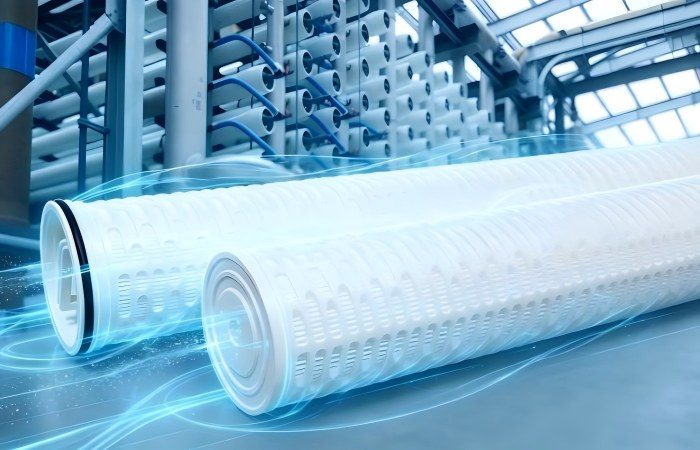
“How long will my high-flow filter cartridges stay operational?” This is the most frequent technical question from facility managers, water treatment engineers, and procurement specialists across industrial, municipal, offshore, and food & beverage filtration projects. Many teams rely on rough guesses for cartridge change-out schedules, which leads to two costly outcomes: premature filter replacement that inflates consumable OPEX, or delayed swap-outs that trigger excessive pressure differential spikes, membrane fouling, and unplanned system downtime. This industry technical guide outlines standardized baseline service lifespans for high-flow cartridges, breaks down all decisive variables impacting durability, and delivers actionable engineering strategies to maximize dirt-holding capacity and extend usable filter runtime.
High-flow filter cartridges serve as the primary protective barrier for large-volume fluid processing systems, including reverse osmosis pretreatment, industrial circulating water, offshore produced water, and municipal water purification. Unlike standard small-bore filter elements, pleated high-flow cartridges adopt an outside-in gradient-density media design that delivers far higher throughput and contaminant retention capacity. Their service cycle is never a fixed number—it fluctuates widely based on fluid chemistry, operating parameters, filter construction quality, and pretreatment efficiency. Below we cover industry-standard baseline lifespans across mainstream working scenarios:
Standard Baseline Service Lifespan of High-Flow Filter Cartridges (Field-Verified Benchmarks)
- Municipal Tap Water / Low-turbidity raw water (SS < 10 mg/L)
- Industrial Circulating Cooling Water / Light wastewater (SS 10–30 mg/L)
- Offshore Produced Water / Heavy industrial wastewater (High colloids, oil & suspended solids)
- Food, Beverage & Pharma Purified Water (Low particulate, strict hygiene standards)
4 Core Technical Factors That Shorten or Extend High-Flow Filter Lifespan
1. Raw Water / Feed Fluid Quality & Contaminant Load
Volatile turbidity, suspended solid concentration, colloidal gel substances, iron/manganese deposits, and seasonal sediment surges directly accelerate media blinding. Fluctuating feed water parameters create uneven particle accumulation on the filter pleats, causing rapid ΔP rise and cutting service life by 30%–60% versus steady water sources. Incompatible flocculants, antiscalants and coagulant aids generate sticky organic layers that block the filter’s effective filtration area.
2. Filter Media Structure & Manufacturing Quality
Two distinct cartridge constructions produce massive lifespan gaps:
- Low-cost uniform-density filters: Identical pore sizes across all media layers, only the outermost pleat captures pollutants, ultra-low dirt-holding capacity, often requiring replacement 2–3x more frequently.
- Premium graded-density high-flow cartridges: Progressive pore structure (coarse outer layers for large debris, fine inner layers rated 5±0.5μm for micro-particles). This full-depth filtration architecture boosts contaminant retention volume by up to 60%, drastically prolonging operational cycles.
3. System Operating Parameters
- Pressure differential (ΔP): Frequent pressure spikes, water hammer from repeated equipment start-stop cycles generate mechanical stress on pleated media, accelerating fiber fatigue. Normal, slow ΔP rise within manufacturer limits counts as predictable wear.
- Flow velocity & liquid viscosity: Overrated flow increases shear stress on filter media; high-viscosity fluids slow permeation and speed surface cake fouling. Both reduce effective cartridge runtime.
- Continuous vs. intermittent operation: Systems running 24/7 with stable flow always achieve longer relative service cycles than frequently cycled units.
4. Pretreatment System Performance
A well-tuned pretreatment process acts as the first line of defense for high-flow cartridges. Optimized coagulant dosing, properly matched antiscalants, and stable pretreatment effluent cut particulate loading drastically. Neglected, uncalibrated pretreatment equipment transfers excessive contaminants downstream, slashing filter lifespan by more than half.
Field-Proven Strategies to Maximize High-Flow Filter Service Life
- Stabilize feed water sources to eliminate sudden turbidity spikes and seasonal contaminant surges.
- Standardize full pretreatment workflows: calibrate chemical dosing rates, select water-source matched treatment reagents, and strictly adhere to site SOPs for consistent pre-filter effluent quality.
- Specify graded-density, branded high-flow filter cartridges with multi-layer depth filtration instead of low-cost uniform-density alternatives to leverage superior dirt-holding capacity.
- Regulate system operating parameters within the cartridge’s rated threshold: avoid over-flow, minimize frequent start-stop cycling, and monitor ΔP daily to schedule predictive maintenance before full clogging.
Conclusion
There is no universal answer to “how long high-flow filter cartridges last.” The baseline 3–6 month cycle for municipal water only applies when all operating conditions remain ideal. Feed water contamination, inferior filter construction, unstable system flow, and inefficient pretreatment are the four dominant drivers of premature cartridge failure. By aligning filter selection with your site’s fluid characteristics, standardizing pretreatment protocols, and monitoring real-time pressure differential data, filtration teams can accurately predict replacement timelines, eliminate unplanned downtime, and drastically reduce long-term consumable and labor OPEX.
How long do your facility’s high-flow filter cartridges typically last before clogging? Are you struggling with drastically shortened service cycles due to poor raw water quality or subpar filter media? Share your on-site filtration challenges and operational data in the comment section below. If you need customized graded-density high-flow cartridge selection guidance, site-specific service lifespan calculation, or pretreatment optimization technical support for your industrial, municipal or offshore filtration project, send me a direct message for one-on-one engineering consultation.
#HighFlowFilterCartridge #IndustrialFiltration #WaterTreatment #ROPretreatment #FluidFiltration