
Conventional wastewater treatment technologies often reach their limits when faced with highly concentrated, recalcitrant organic pollutants. Enter Supercritical Water Oxidation (SCWO)—an advanced oxidation process that is rapidly emerging as a game-changing solution for the most challenging industrial waste streams.
How SCWO Works: The Science Behind Supercritical Water
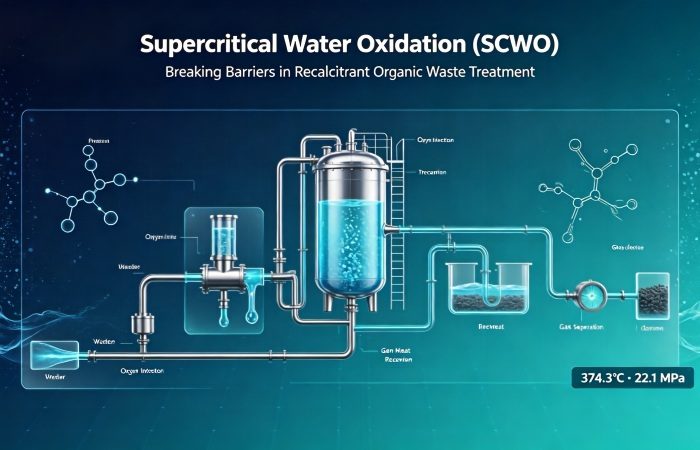
Water reaches its critical point at 374.3°C and 22.1 MPa. Beyond this threshold, water undergoes a dramatic transformation in its physical and chemical properties:
-
The dielectric constant drops from approximately 80 at ambient temperature to just 5–10 near the critical point
-
Hydrogen bond networks are extensively disrupted
-
Water acquires the dissolving capacity of a non-polar organic solvent
This unique state enables complete miscibility with organic contaminants and oxygen, creating a homogeneous single-phase reaction environment. In this medium, organic compounds undergo rapid oxidation, converting ultimately into environmentally benign end products—carbon dioxide, water, and nitrogen. Sulfur and phosphorus constituents are stabilized as highest-valence inorganic salts, while heavy metals are oxidized and immobilized as solids in residual ash.
Key Application Areas
SCWO technology demonstrates exceptional versatility across multiple industrial sectors:
Industrial Wastewater Treatment
-
High-concentration organic wastewater from chemical, pharmaceutical, and food industries
-
Phenolic wastewater and dyeing & printing effluents
-
Complex waste streams resistant to biological treatment
Sludge Management
-
Rapid oxidation of organic matter in sludge into CO₂, water, and inorganic salts
-
Significant volume reduction and stabilization
Radioactive Waste Disposal
-
Treatment of low-level radioactive laundry wastewater from nuclear power plants
-
Processing of spent anion exchange resins
Market Outlook: Steady Growth Trajectory
According to industry research, the global SCWO system market reached USD 121 million in 2025 and is projected to expand to USD 209 million by 2032, representing a compound annual growth rate (CAGR) of 8.12%. This growth is driven by increasingly stringent environmental regulations and the need for effective treatment of persistent organic pollutants.
A typical SCWO system integrates multiple units: high-pressure feed pumps, oxidant supply modules, premixing units, preheaters, reactors, waste heat exchangers, pressure regulation systems, product cooling, gas-liquid separators, salt removal and residue discharge units, central control systems, and off-gas treatment modules.
Technical Challenges and China’s Breakthroughs
SCWO systems operate under extreme conditions—high temperature, high pressure, high salinity, and corrosive environments—presenting several engineering challenges:
-
Reactor corrosion under harsh operating conditions
-
Salt precipitation and pipeline clogging
-
System energy consumption optimization
-
Operational parameter refinement
In recent years, China has made significant strides in overcoming these technical barriers:
-
July 2023: Xi’an Jiaotong University was granted a patent for “A Supercritical Water Oxidation Treatment Method and System,” featuring broad adaptability, reduced construction costs, and enhanced operational safety and reliability.
-
May 2025: Qingdao University of Science and Technology published a patent for “A Supercritical Continuous Oxidation System for High-Salinity, High-Concentration Organic Wastewater,” which achieves anti-clogging performance in feed, salt discharge, and discharge systems while reducing anti-corrosion costs.
Looking Ahead
As industrial complexity grows and environmental standards tighten worldwide, SCWO is positioned to play an increasingly vital role in advanced waste treatment. The ongoing technical advancements in materials science, system design, and energy recovery will continue to drive down operational costs and expand the commercial viability of this transformative technology.
For engineering firms, environmental consultants, and industrial operators, staying abreast of SCWO developments will be essential for addressing the most intractable waste management challenges of the coming decade.
If you found this analysis of supercritical water oxidation technology insightful, please hit the Like button and share it with colleagues in environmental engineering, industrial operations, and waste management. Feel free to share your perspectives on SCWO’s industrial adoption or related technical challenges in the comments.
Follow us for more deep dives into advanced environmental treatment technologies, global market trends, and the latest technical breakthroughs driving sustainable industrial progress.
Keywords: #SupercriticalWaterOxidation #SCWO #WastewaterTreatment #IndustrialWaste #AdvancedOxidation #EnvironmentalTechnology #WaterTreatment #OrganicPollutants #SludgeTreatment #CleanTechnology #SustainableEngineering #IndustrialWastewater #WaterTechnology #EnvironmentalEngineering #ChinaTech