
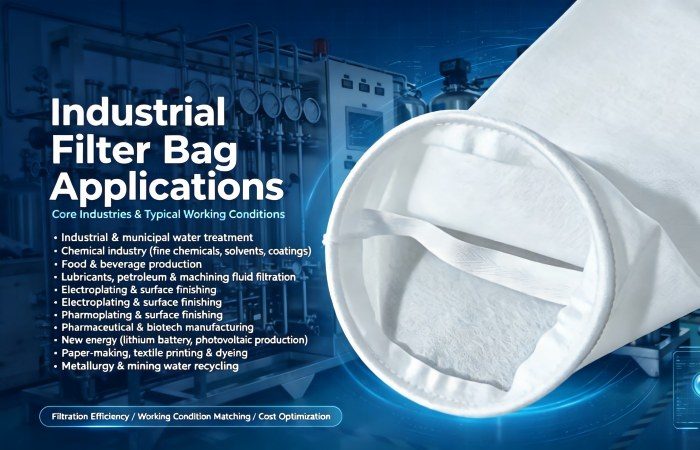
Opening Hook
In industrial water treatment systems, filtration reliability directly determines effluent compliance, downstream equipment lifespan, and overall operational profitability. While most facility managers focus on large-scale filtration equipment performance, the critical role of filter bags — the core consumable of filtration systems — is often overlooked. A mismatched filter bag not only causes suspended solid leakage and substandard water quality but also triggers frequent replacements, unplanned downtime, and excessive maintenance expenses. For water treatment engineers and plant operators, scientific and condition-based filter bag selection is one of the most cost-effective ways to stabilize production and optimize budgets. This article delivers a practical, field-tested selection framework for industrial water treatment filter bags, covering core material characteristics and standard size scenarios to help you avoid common selection pitfalls.
Why Filter Bags Are Indispensable in Industrial Water Treatment
Filter bags serve as the final barrier for impurity interception in industrial filtration workflows, delivering unique advantages that outperform traditional filtration methods in terms of accuracy, adaptability, and energy efficiency. Their core value is reflected in three key dimensions:
1. Guaranteed Effluent Quality & Risk Mitigation
High-performance filter bags can precisely intercept suspended solids, fine particles, colloids, oil contaminants, and other micro-impurities in industrial wastewater and raw water. Whether for industrial wastewater discharge, circulating water purification, or ultrapure water preparation, qualified filter bag filtration ensures consistent effluent quality that meets national environmental standards and production water requirements. This effectively avoids environmental penalties, production shutdowns, and product quality fluctuations caused by unqualified water quality.
2. Downstream Equipment Protection & Lower O&M Costs
Premium filter bags feature excellent dirt-holding capacity and structural durability. They significantly reduce replacement frequency and cut down manual operation and maintenance workload. More importantly, they prevent impurity penetration and bag breakage leakage, which protects key downstream equipment including water pumps, heat exchangers, and membrane modules. By reducing equipment abrasion and clogging, filter bags extend the service life of core facilities and substantially lower long-term equipment repair and replacement costs.
3. Strong Compatibility & High Cost-Effectiveness
Water treatment filter bags boast flexible adaptability and simple installation, requiring no large-scale modification or shutdown adjustment for existing filtration systems. They can quickly adapt to diverse working conditions with different water flow rates and water quality complexities. Compared with conventional sand filtration, cartridge filtration and other traditional processes, filter bag filtration achieves higher filtration accuracy with lower energy consumption, fully complying with industrial energy-saving and emission-reduction requirements, and becoming a high-ROI consumable for industrial water treatment projects.
Core Framework for Filter Bag Selection: Material + Size Matching with Working Conditions
The root cause of most filtration failures — including poor impurity interception, bag aging damage, and short service life — is mismatched material or specification selection. The scientific selection logic is simple: match filter bag material and size with actual water temperature, pH value, impurity characteristics, flow rate, and pressure conditions to achieve a perfect balance between filtration performance and operational cost.
1. Filter Bag Material Selection: Adapt to Water Quality & Temperature Conditions
Common industrial water treatment filter bag materials include Polypropylene (PP), Nylon, and Nomex. Each material has distinct properties in temperature resistance, acid-base corrosion resistance, and mechanical strength, corresponding to exclusive applicable scenarios.
Polypropylene (PP) Filter Bags | Best for Conventional Normal-Temperature Water Treatment PP filter bags are the most widely used universal type in the water treatment industry, with excellent weak acid and weak alkali corrosion resistance. They support a filtration precision range of 1~100μm, capable of efficiently removing suspended particles and conventional impurities in water. Designed for continuous operation at temperatures up to 80°C, with brief peak temperature tolerance up to 95°C, they cover most municipal water treatment, general industrial circulating water, and conventional wastewater pretreatment projects. The prominent advantage of PP bags is ultra-high cost performance with low procurement and replacement costs. Limitation: PP material softens and loses structural integrity under sustained high temperatures above 80°C, so it is not suitable for long-term high-temperature wastewater scenarios.
Nylon Filter Bags | Ideal for High-Impurity & Medium-Temperature Working Conditions Nylon filter bags feature outstanding wear resistance and high tensile strength, far superior to PP bags in structural toughness and pressure resistance. They have moderate acid-base resistance and excellent dirt-holding capacity, making them suitable for high-impurity wastewater, high-pressure filtration, and frequent backwashing working conditions. With a continuous operating temperature of up to 120°C, nylon bags are the preferred choice for medium-temperature industrial wastewater advanced treatment and high-flow circulating water filtration. Limitation: vulnerable to corrosion and aging under strong acid or strong alkali environments, so it is not recommended for highly corrosive water quality.
Nomex Filter Bags | Premium Choice for High-Temperature & Moderately Corrosive Scenarios As a high-performance aramid filter material, Nomex filter bags withstand extreme temperature conditions that PP and nylon materials cannot adapt to. They deliver reliable continuous operation at temperatures up to 200°C, with better chemical resistance and anti-aging performance than PP and nylon, performing well under moderate acid-alkali conditions. They are widely applied in chemical wastewater advanced treatment, high-temperature industrial wastewater filtration, and special working conditions with elevated temperatures. Limitation: Nomex has limited resistance to concentrated strong acids and aggressive organic solvents. For highly corrosive media, PTFE filter bags are the recommended solution. Due to its high material cost, it is only recommended for special working conditions with strict filtration requirements rather than conventional water treatment projects.
2. Filter Bag Size Selection: Match Flow Rate & Treatment Scale
Standard filter bag dimensions are universally standardized to fit industry-standard filter housings. Choosing the right size directly determines treatment flow rate, dirt-holding capacity, and replacement cycle. Below are the 5 mainstream standard sizes widely adopted in industrial liquid filtration, with typical flow ratings for reference:
Size 1 (180mm × 450mm) The most widely used universal standard size, compatible with most standard single-bag filter housings. It delivers a rated flow of approximately 20 m³/h, suitable for small to medium water treatment projects, circulating water filtration, and conventional wastewater pretreatment. Available in PP, Nylon, and Nomex materials, it features easy replacement and broad scenario adaptability.
Size 2 (180mm × 810mm) The extended standard size with twice the filtration area and dirt-holding capacity of Size 1. With a rated flow of approximately 40 m³/h, it is ideal for large-scale industrial wastewater treatment, municipal sewage treatment, and high-flow circulating water filtration systems. It effectively reduces replacement frequency and improves continuous operation efficiency for large-volume treatment scenarios.
Size 3 (108mm × 230mm) A compact mini size designed for small filter vessels. With a rated flow of approximately 6 m³/h, it is mainly used for laboratory water treatment, small precision water treatment equipment, and terminal fine filtration in pure water production. It perfectly adapts to limited installation space and low-flow precision filtration demands.
Size 4 (108mm × 380mm) A medium-compact size with flow capacity between Size 3 and Size 1. Suitable for small to medium pure water pretreatment, small circulating water filtration, and space-constrained industrial water treatment units, balancing installation flexibility and filtration efficiency.
Size 5 (152mm × 520mm) A medium-large standard size with higher flow capacity than Size 4. It is commonly used in medium-flow industrial process filtration, pharmaceutical liquid filtration, and fine chemical production filtration. Note: Please confirm filter housing compatibility before selection, as Size 5 dimensions may vary slightly across manufacturers.
Key Selection Takeaways for Quick Decision-Making
To simplify on-site selection judgment, we summarize the core matching rules:
By Material: Choose PP filter bags for conventional normal-temperature and non-corrosive water treatment (best cost performance); select Nylon filter bags for medium-temperature, high-impurity, and high-pressure filtration scenarios; adopt Nomex filter bags for high-temperature and moderately corrosive special working conditions.
By Size: Size 1 for universal conventional scenarios; Size 2 for high-flow and large-scale water treatment; Size 3 & Size 4 for low-flow, precision, and space-limited filtration scenarios; Size 5 for medium-flow industrial process filtration.
Filter bag selection is not a one-size-fits-all choice, but a precise matching process based on actual working conditions. A scientific selection strategy can effectively stabilize water treatment system operation, eliminate quality risks, and optimize long-term operational costs for enterprises.
If you are struggling with filter bag material and size selection for your industrial water treatment projects, or want to optimize your current filtration consumable solution to reduce O&M costs, leave a comment or send a private message. We can customize a targeted filter bag selection scheme according to your water temperature, pH value, impurity type, and system flow parameters, helping you maximize filtration system value.
#IndustrialWaterTreatment #FilterBag #WaterFiltration #IndustrialFiltration #WaterTreatmentConsumables #PPFilterBag #NylonFilterBag #NomexFilterBag #FiltrationEfficiency #WaterTreatmentOptimization #OperationalCostReduction #IndustrialSewageTreatment #LiquidFiltration